Table of Contents
Stroke
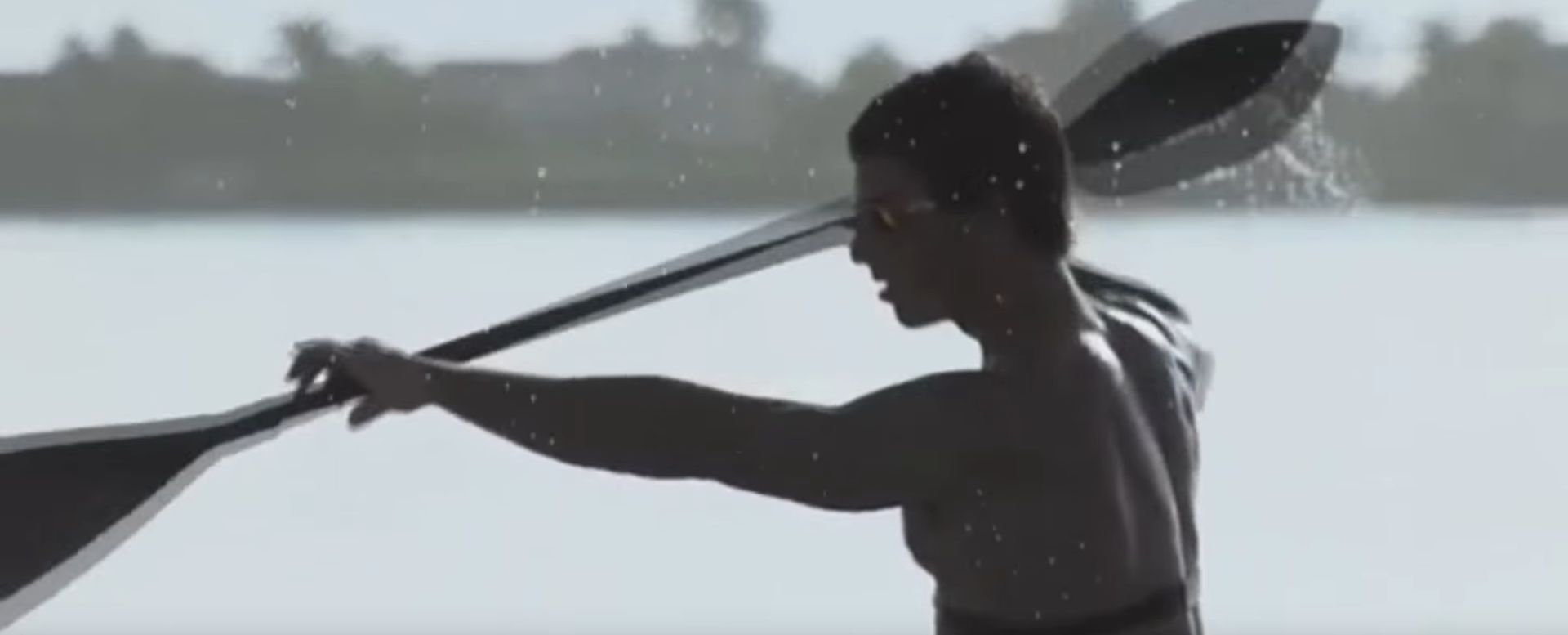
Elements and Sequence of the Forward Stroke
Below are stroke tips picked up from fellow paddlers, blogs, videos, etc. This is an attempt at detailing the ideal stroke. Given the differences in paddling philosophies, bodies and abilities this is not meant to be how we should all paddle. It's a framework to think about the stroke as we all find what works best for each of us. For more expert advice, visit the resources and video sections below and/or seek out acknowledged experts for lessons. And maybe keep in mind that there has been a fair amount of variety in the stroke technique of the very best and most successful surfski open ocean racers. Note also that a good part of the advice below is coming from sprint kayak instructors. Their emphasis on effective power can be helpful in general in terms of good technique, but keep in mind that while your technique may be basically the same, if may only be natural to scale back how much power you apply at the catch and early part of your stroke when you are going for much greater distances than sprint kayakers typically race.
Along the way you will probably notice that many paddlers have strokes that do not necessarily look much like what is described below, but their strokes are effective, they can catch waves, and they have a lot of fun. For most of us that is the bottom line! If you are not young and an aspiring Olympian, you probably don't need to get excessively enmeshed in a search for perfect technique (if you want to, then fine, but please keep in mind what will best keep paddling enjoyable and a lifelong recreation for you). Consider this article from Boyan Zlatarev.
Posture
- Straight back with slight lean forward.
- Sit up on sit bones. Don't roll hips backward.
- Chest open and shoulders down firmly in sockets. Don't over-reach; this can lead to injury.
Comments: As with many technique elements, you will notice significant differences even in successful paddlers. Cory Hill is a good example of a surfskier who employs more forward lean than most. Also, be aware that some surfski buckets are more conducive to slumping than others are. Surfski.info discussion about posture
Setup
- “Pause” at the front of the stroke? Feel the run of the boat. (This is not really a complete stop in movement, but rather a short moment between when the powering blade comes out of the water and the front blade starts to descend toward the water. This “pause” seems to be the dominant technique as of 2020, but some paddlers instead adopt a more continuous cycle without what looks like a short moment with the front hand kept at the same height as the recovery hand is coming up). What we think people are talking about is “separation” between strokes rather than a “pause” - https://youtu.be/_HdHKsppJOg
- Rotate beyond where your blade exited the water. Feel coiled for your next stroke.
- Position the blade at a positive angle for the catch - not perpendicular to the water.
- The high (back) hand for many good paddlers is commonly by the ear on that hand's side at the end of recovery. On the other hand folks may keep the upper hand lower to reduce shoulder strain and make balance somewhat easier in turbulent water.
Catch
- Preload pressure on power foot (same side as the catch).
- Blade enters the water close to the boat at a positive forward angle - not perpendicular to the water.
- Put blade into the water with top (back) shoulder and torso rotation, not hand nearest water nor via leaning the body more.
- Shoulders still in their sockets - don't overextend as this can lose power and lead to injury
- Force is down with weight; not backward with pull. This is how Ivan Lawler likes to describe the power phase. We suspect it is more accurate to describe it as a combination of down and back. Your legs are in front of you, not under you, and your rotation is automatically feeding into backward motion. You can generate downward force as long as your paddle blade has not reached perpendicular. Lawler may be focusing on this first force part of the stroke/catch as downward because that is where the blade should be most positively angled and the most downward force can be applied.
- The catch arm should be almost straight. (some bend is okay - see what we say below in the Drive section about arm bend. The catch arm may be straight or close to straight at the end of setup, but as the blade reaches submersion there can be/should be some arm bend as soon as Drive is beginning)
- Make a minimal splash, slight whiff sound. (sprinting will cause more splash) particularly at the beginning of the stroke. Splashing that continues toward the later part of the stroke can indicate lifting of the paddle blade and too much drive arm participation (bending).
Drive
- After the blade is fully submerged, initiate power by driving down heel on catch-side of the boat.
- When driving down the heel pull up with the opposite foot - think about the bicycle pedal stroke - if this works for you and helps with your hip rotation
- Try to stand up by pushing on heel – straight and tall from heel to head.
- Put weight down on the paddle, not pulling back. To offset the weight transfer down slightly shift your upper body weight to the non-stroke side. This is subtle, but it will keep your boat flat and allow for a much greater transfer of power. Think about a door with the hinge being along the paddle shaft and the door swinging wide over the non-stroke side of the boat. (If you watch videos of good sprint kayakers, the shift to keep the boat balanced is not necessarily that subtle - you will see their non-stroke side bow out and their torso shift to the non-stroke side pretty significantly - but keep in mind that this may be augmented for sprinting as opposed to what is adequate for a longer distance surfski stroke.)
- Key to a powerful stroke is power at the beginning of the stroke.
Keep lower arm straight or almost straight. Imagine you are pivoting around the spot with the blade stationary in the water; boat moves past the blade, not vice a versa.This advice is a bit off… You do not want to be bending your power side arm excessively or arm paddling (trying to use your biceps too much instead of rotating (but the biceps are definitely engaged)), but as soon as power starts to be applied for most paddlers there is a slight bit of bend in the arm. Max power from the legs and rotation cannot be fully applied by most paddlers with an arm that stays completely straight. Also you want the wing blade to follow its natural drift outward while staying perpendicular to your boat. If you force a completely straight arm throughout your power phase, are you still letting your blade follow its most efficient path? And how smoothly can you make a rapid transition between completely straight and the fairly bent recovery position? The explanation and visual from Ivan Lawler's video (Day Six Lower Arm) is better than we can explain with text. He calls this slight arm bend “somewhere between straight and (what he calls) broken”. This arm bend can be a little hard to see in paddler videos between the catch and exit, but if you slow down technique videos (e.g. with youtube playback speed settings) you should be able to see it more easily and how quickly the transition occurs between this slight bend (where Mr. Lawler says you are basically “holding on” with the lower arm) during power application and when the lower arm rapidly bends during recovery. Also watch paddle2fitness (facebook reel)
- When driving heel down hold toes back - don't tap your steering with each stroke.
- Power from heel drives down the knee and rotates hips, core, arms, and paddle.
- Shoulders push down, chest pushes up in a squeeze feeling.
- Keep paddle shaft parallel to your chest as chest rotates and arms are fixed. Don't let hand outpace core.
- Elbow and shoulder of upper hand move in a plane to opposite knee. (Most people do not have arms as long as Oscar's, don't lean too far forward in order to actually touch you elbow to knee - this is really just to emphasize the rotation you want to achieve)
- Upper hand travels across at about eye level (or at the level that works for you, but higher than the eyes is really not necessary)
- Weight goes down shaft, not to the side.
- Feel the rotation of hips and the torso - in the earlier part of the drive they will move fairly close together
- Video of excellent hip rotation no spray skirt so hips are visible
- If you rotate your torso without your hips you will achieve less power in your stroke.
- Rotate forward moving your bottom away from back of the bucket, not pushing back into the back of the bucket. Watch this overhead video showing rotation
- Match leg drive to rotation - leg should finish in the down position just as your hip rotation finishes.
- Keep knees centered. (like much of these kind of instructions this is a generalization that will vary in terms of your specific body type - but the idea is to have your knees “centered” in terms of how your knees work - ideally not completely splayed outward or held too tightly against each other)
Exit
- Use the forearm to exit - feels like exiting with the back of your hand. Don't lift shoulder - raise arm while bending at elbow and keeping the elbow down
- Continue to rotate with your torso if comfortable (can you do healthy stretching that increases your torso rotation to aid this?) after blade exits.
- Exit hand finishes approx. at ear level (again this is idealized) for setup.
- Keep pressure on foot stretcher.
- Relax hands and body on exit and for setup.
Cavitation (or is it Ventilation?)
From Guillemot Kayaks (with a couple of notes from our wiki editors):
“Ventilation is what you call it when the paddle sucks air down the back of the blade. Many people call it cavitation, but that is when a propellor spins (Ed. or any object moving fast enough in water) so fast that it creates a vacuum behind the blade (Ed. Note: this is not really vacuum formation, but rather the formation of low pressure space behind the moving object or blade that causes water vaporization). Neither ventilation nor cavitation would help your paddling, but what your average kayaker creates is ventilation. The reason it is no good is you are moving air instead of water. Air weighs a lot less than water and if there is air behind your paddle instead of water the mass of water you are moving is decreased and thus creating the same momentum requires you expend more energy.
There are two ways of creating ventilation. One is by bringing the air down with the blade as you insert it into the water. The other is to pull air down the back of the paddle as you apply power. Both can be avoided by being sure your blade is fully submerged before applying power (Ed. We believe that everyone starts to apply some power before their blades are completely submerged, but the idea is to have your paddle mostly submerged by the time you start to apply the peak of your power). A clean entry will not bring down much air and the small area near the top of the blade is less likely to ventilate.”
More on Cavitation - imperfections in a blade also contribute to cavitation which typically occurs with objects that have some kind of edge (does not occur with spheres). Previously cavitation was thought to only be caused by high speed movement, but it has subsequently been experimentally observed with objects moving as slow as 1 meter per second. So theoretically it may be possible for a paddle blade to cause cavitation, but we currently believe that ventilation is the primary issue that paddlers are dealing with and should try to minimize.
Cadence
- For downwind runs you must be able to rapidly switch gears and increase your cadence to catch runs. Power in catching waves often has to be applied when you feel the tippiest, so you have to overcome the tendency to drop cadence or brace - if you wish to learn to catch waves well.
Strategies for Improvement
There is no substitute for a good coach. But if you don't have a coach, have a friend videotape you. Compare your stroke to videos of paddlers you are trying to emulate. Since the stroke is complex, one strategy that can be helpful is to pick just three elements to work on during a practice. Focus on one element at a time. Rotate among the elements during your practice.
Rotation
Stroke Balance
Putting it All Together
If/When you want to advance to rougher conditions and stronger downwind paddling
Other Strokes
We didn't start to add detailed information about these strokes until year 3 of this wiki, so like many surfskiers we know, we are also guilty of neglecting these vital and very valuable strokes that a surfskier can benefit from in their paddling and downwinding.
Sculling
Power Side Sculling in a K1
.
You can use sculling strokes to move sideways and/or stay upright effectively. (The draw stroke is your other main option for moving sideways) How many paddlers have experienced letting their paddles dive followed subsequently by themselves falling into the water? You can insure that your paddle remains on the surface and provides active support with a sculling stroke. Your paddle blade needs to be somewhat angled away from your boat to get some upward support. These strokes, particularly the vertical version because it uses the cupped side of the blade for power, may feel very awkward at first, but a little regular practice will lead to comfort, competence, and the ability to confidently rely on these techniques.
- Power/Cupped Side Scull (more vertical paddle position)
- Use this one to move sideways while providing active support to keep you upright
- Use the cupped side of the blade for pressure against the water (just like the forward stroke). For many paddlers using the cupped blade side like this will not at all be easy without some legitimate practice.
- Keep your paddle angled slightly outward away from your boat on the side you are sculling (paddle blade in the water farther out than the top blade - but the stroke position is still more vertical than horizontal)
- Your paddle goes sideways parallel to your boat back and forth with the leading blade edge angled slightly farther out/higher than the other edge to provide lift and keep the paddle from diving regardless of which direction the paddle is going. Turn your paddle blade that is in the water to keep the leading edge above the trailing edge and the power being applied to the cupped side (figure out whether you are more comfortable using your normal control hand to control your blade angle on both sides or simply use your bottom hand on each side for this - you will be changing your blade angle each time you change direction in the scull)
- You can adjust the position of your paddle toward the front, back, or straight sideways to control the direction that you are pulling your boat
- Non Power/Back Side of Blade Scull (more horizontal paddle position)
- Use this as an active support stroke while your boat is stationary - providing continuous support and extra stability and avoiding paddle dive
- This is a scull pretty much using your low brace position (you can position the paddle more perpendicular to the boat (straight out from the boat) if you want more leverage)
- angle the leading edge (edge leading whichever direction the blade is currently going toward) of your sculling blade slightly upward so the your sculling blade will always stay on the surface and not dive.
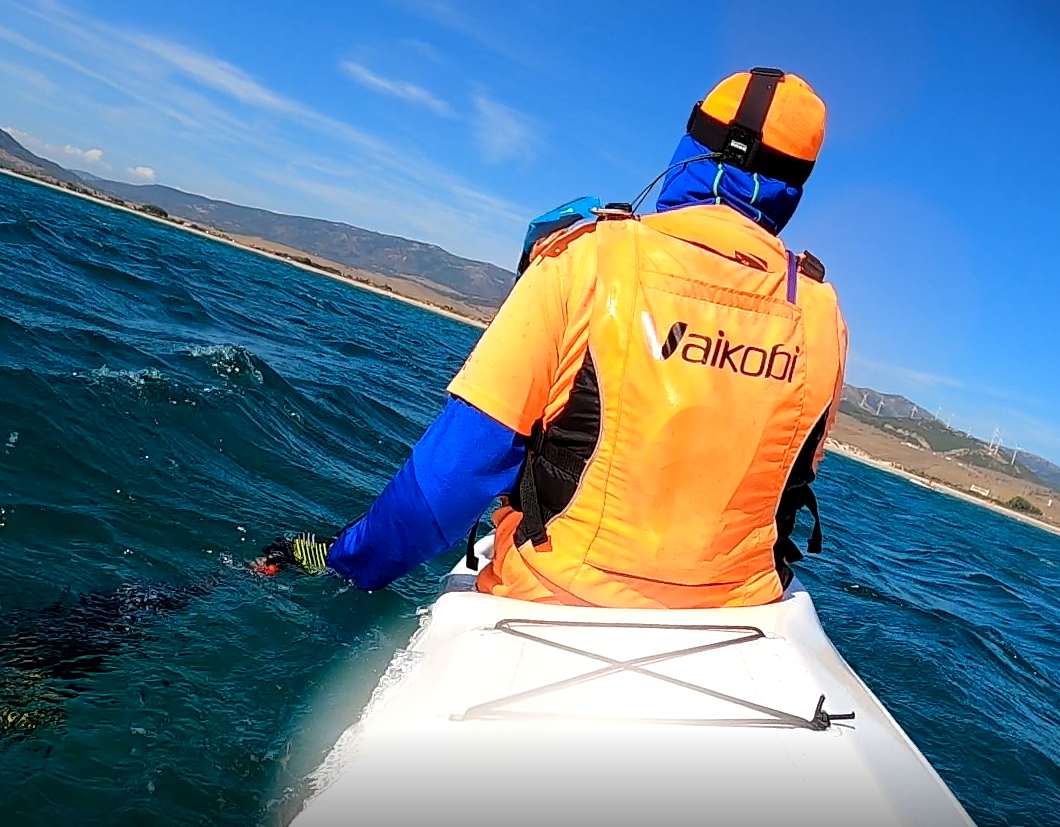
Pre-swim paddle dive
Bracing
- Low Brace - typically putting the non-power side of one blade (occasionally low braces are done with the blade's power side in canoes) more or less flat on the water surface at a 45 degree angle behind you. Your wing paddle will generally be as close to horizontal as practical given that it has to angle over your boat. Both hands are kept low vertically. Sometimes people rest the paddle on their legs or lap. (one of Oscar Chalupsky's energy saving tips and how Boyan Zlatarev teaches it) . Boyan teaches a slight lean to the side that you brace on. You can lean more to the brace side if you need to apply more weight on the brace, but the point is to keep your boat upright - generally you do not lean a lot and you just apply very light pressure to maintain contact to sense the available support while minimizing drag and speed loss. This is the kind of brace used by surfskiers (OC's also use a low brace with their single blade paddles). You need to practice and get completely comfortable with both sides (if you feather your blade angles, bracing on one side will likely seem more awkward at first). This brace is also often used for support on the side you are turning toward if you are on a wave. With more pressure it can act more like a rudder assisting side wise turning but also reducing speed more.
- Exceptions: As with many things, there can be exceptions to the brace position just described. If you are in very choppy water and/or in waves that are coming from one or both sides behind you, when you brace you may want to keep your blade farther forward rather than behind you at a 45 degree angle, so your paddle is less likely to get submerged/surprised by side/backside waves which would otherwise cause you to pull yourself into the water when you try to recover your bracing blade. Similarly in such conditions it is also a good idea to concentrate on keeping your forward stroke blade recovery no later than beside your body (or earlier) to reduce the likelihood of the finish of your stroke coinciding with a wave landing on top of and trapping your recovering blade.
- High Brace - recovery support and sharp turn stroke (high brace turn) on one side with higher (vertically) hand positions using the power side of blade. Commonly used by sea and white water kayakers - proper technique is critical (take care about not letting your hands get too high or too far away from your body - watch video immediately below) because it can put significant stress on your shoulders.
- …
.
Paddler in cross beam waves using low brace on left and high brace on right (notice where he keeps his hands in the high braces (both close to his body and not very high) to limit stress on his shoulders)
Back Paddling
Resources
- Clint Robinson on Stroke Technique (there are 4 pages of these)
- New Zealand Paddler Resources technique and equipment advice (includes text and videos)
- New Zealand Paddler Technique Handbook v2 (view pdf with wiki viewer) or view/download on home site
- Paddle 2 Fitness Julian Norton-Smith videos on technique, exercises, training and video analysis
Videos
- Adam van Koeverden
- Alexandr Nikonorov
- 1 Setup
- 2 Rotation
- 4,5,6 Manage Rotation
- 7,8,9 Run the Boat
- Clint Robinson & Guy Wilding
- …
- Greg Barton & Clint Robinson 3 video series
- …
- Ivan Lawler
- Lawler Technique Series 2020 Classes:
- Jamo Porter (World Paddle)
- …
- Knut Holmann
- Lisa Carrington (no talk - just lot's of footage of her paddling)
- …
- Lukas Bartek
- Youtube Channel lots of stroke stop action and side by side comparisons of top sprint kayaker's strokes
- …
- Paddle Lab
- …
This page has been accessed for: Today 10 / Yesterday: 22 Until now: 384